South Africa Itinerary
 |
 |
 |
 |
 |
 |
 |
 |
 |
 |
 |
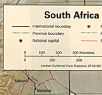
Location Southern Africa, at the southern tip of the continent of Africa bordering the Atlantic and Indian Ocean
Population 43.5 million; approx. 35 inhabitants/km²
Life expectancy 54.7 years
Area comparative about 3 times
the size of Germany or slightly less than twice the size of Texas
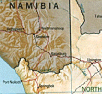
Border countries to the north from east to west are Mozambique, Swaziland, Zimbabwe, Botswana and Namibia
South Africa is "A world in one country", a vast land of varied terrain ranging from arid desert to lush costal plains, from low bush country to high mountain ranges
Planned arrival September 2003
October 30, 2003 Garden Route and Winelands
Breaching whales and unsuccessful Springboks
Although we had seen a few whales around Madagascar and the Cape Peninsula,
we could not resist the reputation of Hermanus as one of the best places
to watch whales from the shore. Initially we were welcomed by rainfall
which made whale watching a rather wet activity. The forecasts had not
been promising but the next morning greeted us with sunshine and almost
blue skies. Watching the Southern Right Whales teaching their calves how
to blow, breach, tail sail, spy hop, tail lob or roll over is amazing
and Anja could have spent hours just sitting on a rock and enjoying the
sight of one of the gentle 15 tonners (for some more info go to http://www.warrnambool.nu/whales).
Our guidebook suggested that Die Kelders just around
the bay from Hermanus is not as touristy as the latter but even better
for watching whales. On the way there we went on a very informative and
personal tour (for the two of us) at the Birkenhead Brewery in Stanford.
The Master Brewer himself gave the tour and invited us to join the crowd
the next day for the Rugby World Cup match
The rugby crowd was fun to be around but the South African team, the Springboks, although much loved and cheered for let the fans down by loosing. We did manage to pick up some of the rules but most of the time it just looked as if thirty big men were trying to find an Easter egg.
Active on shore and on water
Knysna Forest
On the way into the remaining pieces of the Knysna forest, we were amazed
by the warning signs for wild elephants. Regardless of other persuading
stories heard before the forest office convinced us that there are three
of the original Knysna elephants left roaming the remote parts of the
forest. We looked out for elephant dung when walking the nine-kilometre
black elephant trail through Tarzan and Jane-like forest. After the hike
we decided to spend the night on the forest office’s campsite. Had we
had a free-standing tent, we would have been able to pitch it on one of
the designated wooden platforms in the forest. With our tent however,
we tried to find the most level grass patch on the slope. Nevertheless,
it was a very pleasant place to stay with the nightly forest sounds surrounding
us and us being the only campers there.
Plettenberg Bay
When you might be thinking that we are currently leading a nice life,
there are others who have it even better organised. Clayton, is spending
the winter (Northern hemisphere summer) months on Hawaii giving surfing
lessons, is living the summer (Northern hemisphere winter) season in Plettenberg
Bay guiding kayaking trips and is surfing and spending little money in
Indonesia during the two remaining months of the year. What a life! We
were fortunate to join one of his sea kayaking trips in Plet’. Unfortunately
only two seals showed up when we were kayaking the lagoon but the hefty
wind strengthened our shoulders. Despite the lack of animals and some
problems with the rudder we thoroughly enjoyed the few hours on the water
and the hot shower and tea thereafter.
Tsitsikamma National Park
Bus loads of Germans and Americans some with name tags (Keith, Liz &
Sandy were popular names) who had been given just enough time to walk
to the Suspension Bridge over the Storm’s River Mouth joined us on our
walk there. Mischievous as we are, we took some pleasure in making the
bridge swing just a little…
Thereafter we set out for a waterfall with a rock pool beneath it which meant to walk the first three kilometres of the Otter Trail. The trail is the flagship of hiking trails in the South African parks - traverses 42 km of rugged coastline, with the booming breakers of the Indian Ocean on the one side and fynbos and indigenous rain forest on the other, crossing eleven rivers on route to Nature's Valley. We were not the only ones hopping from one boulder to another but we did not encounter any more name tags. One lady was brave enough to tackle this section with flip-flops. Hats off! We also compliment those who embark on this section of the trail with full backpacks in order to walk the five-day Otter Trail. Unfortunately, one must be either really lucky or apply over and over again to be one of the few who are allowed to walk the trail each day.
Insiders gave us the opportunity to walk another section of the Tsitsikamma National Park. Climbing several fences and walking over many meadows, we found the gate that had been pointed out to us and carefully slid down the slope towards the rugged coastline. Atop of one of the tidal pools we sat down on some rocks for an hour or so and just took pleasure in studying the waves and the tidal current. The stretch we walked is part of the new Dolphin Trail which has been set out for tourists who would like to walk something similar to the famous Otter Trail but do not want to carry a backpack nor do without the comfort of a hot bath in the evenings (and do not mind to pay a significant amount of money for it). Climbing up the steep hill to their first stop for the night must take some of them a while and they are probably more looking forward to a cold shower than a hot bath…
Family McEwan has a farm – Ee i ee i o
And on their farm they have…oh well, just about anything we could dream
of: a cosy room with a large and comfy bed, plenty of shy young moo-moos
with big staring eyes, lots of clean air, three seemingly inseparable
woof-woofs, about 500 milk cows to perfume sweaters with in the morning,
a lovely kitchen where we were allowed to cook cluck-cluck for our hosts,
two sleepy meow-meows, a stunning shoreline in front of their doorstep
and much more. We even got some enlightening insights into cricket! Thanks
again for three very enjoyable days!
Sipping and spitting – Wine sampling in and around Stellenbosch
We had chosen two wine estates which we definitely wanted to visit – Vergelegen
for the Cape Dutch architecture and Kanonkop for the wine. The McEwans
added a third to the list, Camberley. Nestled up at the Helshoogte Pass
between Stellenbosch and Franschhoek, John Nel makes wine tasting a private
and communicative experience. In addition, his wines, only reds, are excellent
and we have added them to our investment list once we are back in good
old Europe and have earned some money. There was no way we could have
driven down the slopes of Helshoogte Pass after this tasting. Hence, we
stayed in their beautiful cottage for a night. Johnny filled our next
morning by giving us his top seven winery list for Stellenbosch. We managed
to visit four of those after which Christian had a big smile on his face
and we both needed lunch. The Simonsberg cheese factory outlet was exactly
the right place to provide for this.
After filling our tummies and regaining control over Christian’s facial muscles we headed for the goat tower at Fairview (please see corresponding picture) but soon after hit the long N1 towards Johannesburg.
Tonight, after all the packing is done and we are set for some serious backpacking again, we will enjoy a last bottle of wine along with seeded bread and cream cheese. What a treat!
October 16, 2003 On our way to Cape Town
Best accommodation surprise
After a few complimentary cups of Rooibos tea at the oldest and biggest
Rooibos factory in Clanwilliam we flipped through our guide book to find
a place to stay in the Cedarberg region. Spontaneously we fell for a good-value
chalet setting after four weeks of camping. And it was great! We had our
own 250-year-old Cape Dutch farm building converted into a guest cottage
set amidst a blooming orange orchard. The kitchen enabled us to treat
ourselves to dinner ‘at home’, baked scones and freshly squeezed orange
juice for breakfast – just lovely!
The perfect place to live?!
Set against Table Mountain, surrounded by two oceans, blessed with a mild
climate with fast changing weather conditions, friendly inhabitants and
pleasant city life – what more could one ask for? If there were not the
difficult visa/work permit regulations, we could definitely picture ourselves
living around the living around the Cape Peninsula.
We were assured by two extremely generous accommodation offers.
The first awaited us when we first arrived in Cape Town. Trying to find
Youth for Understanding’s office (our former exchange organisation) we
had to discover that we had an old address of theirs. In the search for
the current one we rang the bell at the Bergzicht guest house across the
street. While Anja was still on the phone talking to YFU, the friendly
owner decided that he liked our faces and showed Christian his bed for
the night. Astonishingly the warm welcome included a divine breakfast
and the offer to pay as much as we could afford.
The second accommodation offer came from Maureen, a Jersey native who
we had met changing a tire in
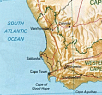
Although we were rather lazy, we did accomplish a climb up Table Mountain, we did enjoy watching the penguins at Boulders’ beach where some of us even dared to go in the (freezing) water, we went on a very informative tour of the Hout Bay township, we did visit the Two Oceans Aquarium and went on an educative trip to Robben Island, the prison where Nelson Mandela spent 18 years of his life.
From here we will drive along the
October 1, From mist and snow to semi-desert
Leaving Durban we headed for Umkomass where Christian was planning to
go diving with sharks at the Aliwal Shoal reef. Unfortunately, the conditions
were too misty and too rough for launching the boat and so we simply hung
out at an extremely laid back (loads of dope heads and/or surfer dudes)
backpackers place in Warner Beach for two days. A British couple who was
just wrapping up their eight month journey from the
Soon after we left the coastal region, the weather turned dry and sunny again, giving us some splendid views of the Drakensberg.
Sentinel - snow away from home
Arriving at the Sentinel car park (at about 2800m) in the Royal Natal
National Park we luckily chose the adjacent hut over our tent as the upcoming
night brought a colossal thunderstorm and loads of gusty breezes. In the
first light of the new day a big rainbow span over the valley highlighting
the snow on the surrounding peaks which had fallen during the night… The
fact that not even the hut’s caretaker would consider hiking the Drakensberg
that day reassured us that it was time to move on. Mow we had plenty of
time to slowly move along the Highland Path hugging the Lesotho border
through the Golden Gate National Park and plenty of sleepy but well-kept
small towns. (Collecting more stamps in our passports we even went into
Bloemfontein to Upington - fencing nothing
After a good night’s rest in Bloemfontein we restocked our groceries,
strolled through town and then headed on for Kimberley, home of the DeBeers
diamond group. It was only then that we discovered a new but constant
companion to our road travel in
The place we stayed in at Kimberley had the charm and looks of military barracks, but for dinner we treated ourselves to Spurs, a steak-house chain, where Anja made full use of the offer to buy-a-small-plate-and-go-as-often-as-you-like-to-the-salad-valley.
The next morning we set out for Upington. Guess what we saw
along the way? Yup, fences and nothing else on these long straight roads
with hardly any traffic. Sadly, Upington did not manage to provide any
change in this dullness. We had no desire to put more kilometres on the
car that day but got so bored in the town that we made an effort to keep
ourselves busy by cruising around. As Spurs had made us happy in Kimberley
we aimed for it again but the salad valley was petite. Instead, we met
Elizia who had been a YFU exchange student to
Nobody had been at home at the two backpackers’ places thus we set up our tent at the caravan site just outside of town. It turned out to be much cheaper anyway and we enjoyed chatting to the South African family next to us. Although traveling in our own car is comfy, we are missing the frequent contact with the locals.
September 14, 2003
Durban
September 13th was a very sad day, the one that we lost our diary. We
had forgotten it together with an issue of The Economist on a table close
to the bar at a Backpackers' hostel between Swaziland and St. Lucia. The
day after we found the magazine neatly tucked away on the bookshelf but
the diary had vanished. We do not know whether a cleaning lady didn't
think it important enough to look at or whether some fellow traveller
is currently enjoying the read. We will have to safeguard all of the memories
from Tanzania, Malawi and Madagascar in our heads and are grateful that
we have recorded some tales on the website.
Independent Swaziland
Differences struck us in the little Kingdom of Swaziland. On the one hand
the highly developed yet laid back cities of Mbabane and Manzini, on the
other the vast and truly African open spaces with traditional beehive
hut villages. One side of a valley is covered with sugar cane plantations
constantly being watered, the other side where the people live is eroded
and there is no water as far as the eye can see. Here are business men
sitting next to us in a pleasant sauna discussing joint venture plans
for Malay high-tech products, there is a king ruling the country who chooses
as many wives as he likes during the annual reed dance performed by Swazi
maidens. So far he has only gathered eleven which is rather conservative
compared to his predecessor who brought the figure close to eighty.
Showing off in Sodwana Bay
According to the guidebooks, Sodwana Bay is blessed (?) with the biggest
campsite of the Southern hemisphere. This might well be the case but we
were lucky enough to enjoy it midweek and a few days before school holidays
start. Arriving at 5pm we had the beach to ourselves which is normally
packed with Jo'burgers and their 4WD vehicles. Without the crowds this
is quite an enjoyable place reminding us of the French Atlantic coast.
The next day Christian logged two more dives in his logbook whilst Anja snorkelled closer to shore seeing almost the same amount of fish... Visibility was worse than on Madagascar but these South African diving folks are professionals. The dive experience started by entering one of the high powered launch boats almost flying through the surf with skippers as seen in Baywatch and was completed by beach assistants for the divers who were unable to free themselves from the wetsuit.
Animals from a long forgotten time
Getting up before sunrise to enter the gate of the Hluhluwe-Umfolozi Game
Reserve as the first visitors that day was rewarded by the sighting of
many rhinos (both black and white), three extremely unfriendly elephants
who made us back up as fast as the car permitted in order to leave their
territory, and many other game. For now, our thirst for the big five has
been quenched which might allow us to live within the constraints of our
budget. Nevertheless, we will take in Kgalagadi Transfrontier Park between
South Africa, Botswana and Namibia as well as Etosha National Park in
the North of Namibia.
It's raining men
All of the dust that the car collected during the eight-hour game drive
in Hluhluwe-Umfolozi (two parks were actually combined to produce this
unpronounceable name) was washed off on the second day in the St. Lucia
Wetland area. Instead of spending a day venturing out in the search for
hippos and crocodiles, the first day of continuous rainfall (since we
started our trip) made us head directly for Durban. It is still raining
but that at least gives us enough time to exchange most of our torn hand-washed
t-shirts for new ones and enjoy Durban's shopping malls. We are bound
to stay in Durban until Monday as we have to get a new front license plate
which decided to stay somewhere on the road in Swaziland...
Hopefully the weather will improve before we head for Umkomass for more underwater world adventures on Tuesday.