Namibia Itinerary
 |
|
|
|
|
 |
 |
 |
|
|
 |
 |
 |
|
|
 |
 |
 |
|
|
 |
|
|||
 |
|
|||
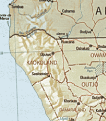
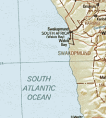
Location in Southern Africa bordering the South Atlantic Ocean
Population 1.8 million; approx. 2 inhabitants/km²
Life expectancy 41.2 years
Area comparative 2.5 times the
size of Germany or slightly more than half the size of Alaska
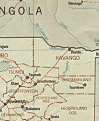
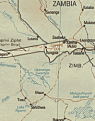
Border countries to the north Angola, to the east Zambia and Botswana and to the south South Africa
Namibia is the driest country south of the Sahara, with constantly blue skies and a comfortable climate
Planned arrival October 2003
October 16, 2003, Stories from Namibia
Most enjoyable morning
Jeanne, a housewife who loves kayaking, offers a very special way to experience
the marine life at Walvis Bay. The drive to The Point where we were going
to launch the sea kayaks already revealed how well she knows the area
and its human and non-human inhabitants. She entertained and educated
us with stories during the 40 minute ride and taught us how to deflate
tires properly for them to master thick sand.
Although the air was a bit chilly that morning, the paddling soon kept us warm. We first passed the nearby seal colony in order to spot some dolphins and/or whales. The whales did not make an appearance that day but a dolphin dove directly underneath of my kayak. An amazing sight! We later returned to the seal colony whose inhabitants were delighted to play around with the kayaks much to our joy. They were obviously enjoying splashing us and hopping onto the kayaks as much as we took pleasure in having them so close to us.
Most frightening encounter
Leaving Walvis Bay behind us we soon hit gravel roads again entering the
Namib Desert. A turn-off led us onto an even smaller road through the
empty and plain desert. The campsite bared any facilities as well as other
campers; however, had the stunning orange-coloured sand dunes within walking
distance. After pitching the tent we went for a stroll across a dried
up riverbed towards the dunes. Judging by the footprints in the sand,
other human beings had been here before. A sudden distinct animal smell
caught our nostrils and made us halt. Animal experts as we thought we
were by now we immediately related the smell to elephants. Even though
we could not spot the big grey mountains, a shaking large bush full of
fresh green leaves made us reconsider our plans. We changed the path and
carefully tip-toed forward. A bit further, we dared to peek back only
to discover a smelly but harmless donkey…
Most breathtaking but most rewarding experience
Because we only had a 2-wheel drive rental car and none of the 4-wheel
drives decided to stop, we started to walk the last five kilometres towards
Sossusvlei, an area of the largest sand dunes in the world and one of
Namibia’s main tourist attractions. The driver of a lodge vehicle had
some mercy and gave us a lift. He was also so friendly as to point us
in the right direction towards the Dead Vlei, an old pan which has not
had regular water since the river changed its course. Left there today
are the skeletons of old acacia trees, some of them well over 500 years
old according to the national park’s office.
We first tackled a small dune which many had struggled upon before us. Hence, it was easy to follow in their footsteps. Back in the pan we first tried to capture the surrounding beauty in many photographs and then decided to embark upon another ridge. Catching our breath we watched two others struggling their way up in our footsteps. They turned out to be Italians and were determined to go all the way to the top of that dune. As they volunteered to do the hard work of laying out the track along the ridge, we followed suit. At one point all of us had no choice but to reach the next ridge by crawling straight up the dune. Anja, sitting on the ridge, took much pleasure in photographing the three strong guys who were lagging behind ;)
After all we did reach the top having shared four litres of water between the two of us on the way up. The bird’s eye view was astonishing and well worth the sweat. Above us the deepest of blue desert skies, around us red sand everywhere and at its base the Dead Vlei, a sea of white, talc-like clay. This salt pan beneath did not look far away but we later discovered that we had tackled ‘Big Daddy’ at about 325 metres believed to be the world’s biggest sand dune. Again catching our breath after having run straight down we created a new small dune next to ‘Big Daddy’ by emptying our shoes.
Most beautiful stretch to look at
From Sossusvlei south the map marked the road as scenically remarkable
and rightly so. It is an endless red/yellow/grey/green-earth rollercoaster
road through ever-changing landscapes. Next neighbours live 30-40 kilometres
apart and unlike in other places where sheep are counted per hectare,
Namibian farmers count 30 hectares per sheep... Most stretches of the
road were well maintained and we learned to deal with the heavily corrugated
ones by virtually “flying” over them. That way the wheels did not have
to dip into each groove deepening and the car and us avoided to be thoroughly
shaken. Many worn tires along the pads/roads are evidence of others who
were not that lucky.
We wondered why people chose to live here where one needs to drive over
80 kilometres just to fill up the car and more than that to the next supermarket.
Nevertheless beautiful to look at!
Least expensive accommodation
The Luederitz Backpackers’ was not to our liking: booked out by an overland
truck, the grass patch too small for pitching our tent, the ablution facilities
could have been cleaner and that all for a price which is comparably expensive.
After talking to a local shop owner we were convinced to camp wild in
the vicinity of Grosse Bucht. Neglecting the ‘No overnight camping’ line
on the sign at the entrance to the reserve, we drove out of Luederitz
after spending some of our budget on a decent meal.
South of town there are some beautiful bays and lagoons but the wind is Atlantic cold. We chose the least windy place, parked the car and decided against putting up the tent. Instead, we spent the night in the car which turned out to be rather comfortable and warm!
October 1, 2003, Former South-West
Africa and Namibia today
Whereas South Africa already didn’t feel like the Africa we had experienced
in Tanzania, Malawi and Madagascar, Namibia is still very much influenced
by the descendents of the German Schutztruppe (colonial troops). Although
the SWAPO government has recently changed most of the street names, main
street in Swakopmund is no longer named Kaiser Wilhelm Strasse but now
Sam Nujoma street, the Baeckereien (bakeries), Wurstbuden (sausage kiosks)
and Apotheken (pharmacies) are still everywhere. Walking around the bigger
towns and all of the lodges one frequently hears German being spoken both
by locals and tourists. Christian had planned our route in such a way
to be back in Windhoek for the October 3rd celebrations and
was very disappointed to learn that it is by invitation only. On Madagascar
we would have been warmly welcomed!
Making our own observations and talking to the manager of Bushveld Park lodge just south of Etosha National Park we learned that not everything is going well in Namibia. The constitution has been changed to allow the first president of the Republic of Namibia, Sam Nujoma, to stay in office for a third consecutive term. The president’s portrait photo has to be put up in every official office including the bureaus of the Namibian Wildlife Reservation Service. Lots of money seems to be spent on commemorative plates everywhere in the country all being unveiled by His Excellency The President Doctor Sam Nujoma.
There are plans to reallocate farming land from the whites to the blacks by dividing up farms. Apparently, all of the current farm owners have already difficulties to make a living on farming alone. Most of them offer game hunting and tourist accommodation. Fears are imminent among the whites that the happenings in Zimbabwe could easily repeat themselves in Namibia. It is definitely a very fragile democracy.
Wild things – radio broadcasts, animals and petrol stations
Turning on the radio after crossing the Namibian border we were amazed
to listen to the click sounds of the local African languages, stunned
by the lethargic broadcasters presenting music on the English radio channel
and astonished to listen to the Hamburger Hafenkonzert (harbour concert)
on the German channel of the Namibian Broadcasting Service. Over the next
days we got our share in German Schlagermusik many songs we had never
heard before, Sandmaennchen (sandman) stories as well as randomised and
badly translated world news.
It got really absurd when driving through Etosha National Park, a hot desert/salt wilderness, watching elephants, lions, giraffes, springboks and many other game species at waterholes while listening to Roland Carpendale. Nevertheless, Etosha is great and definitely worth a visit if you can bear the heat.
Heading for the Skeleton Coast, we passed through Khorixas, a town described on our map as ‘Stop, fill up and leave.’ And that is exactly what we did. Filling up was more difficult than in other towns because we first had to make out the service personnel from all of the touts who were trying to sell something. Getting out of the car Christian was immediately asked for our names which he then chose for the day: Franz and Elfriede. Only minutes later we found out why: ‘Hey, Mr. Franz, buy this Makalani seed for Elfriede.’ The Makalani seed has a yellowish ping-pong ball shape with a brown shell and is as hard as ivory. ‘Hey, Mr. Franz, we have even engraved her name on it next to the elephant and the giraffe. Come buy, very cheap - best price, best price!’ Sadly, Franz stuck to the principle of not buying any crafts or souvenirs and Elfriede only found out later that her name had been engraved…
Lots of changes - roads, tires, scenery, plans and diet
Leaving behind Etosha National Park and Outjo we soon hit gravel roads.
Fortunately our car has not caused us any trouble whatsoever. Over the
6000km we have traveled up to now, we only had to unhook the battery every
once in a while to reset the engine management in order to turn off the
corresponding symbol in the driver’s panel. Others were not so lucky.
The road sides are covered with torn tire belts. Trying to speed to Palmwag
Lodge before nightfall we were upheld by a German couple whose VW Bulli
(Kombi) had suffered a pretty bad puncture leaving nothing of any use
on the steel wheel. Additionally, they had a hard time accessing the spare
wheel as the bolt was locked too tight for their tools. Unfortunately,
our tool kit was not of any help either but we managed to raise their
spirit until another car came our way… The South African family’s 4x4
was much better equipped and we changed the tire in no time. As it was
getting dark and another 70km lay ahead of us we were comforted by the
fact that the 4x4 was following us to Palmwag Lodge.
After initial difficulties of finding a campsite (we had not made a reservation) we ended up spending two enjoyable and relaxing days in Palmwag Lodge. Spike, Laurel, Neil and Maureen, the South African/ Jersey 4x4 family, really made the stay memorable by inviting us to a lovely braai (BBQ). What a great change in our camping diet of spaghetti or rice! And the elephant that felt like walking passed the campsite just metres behind bushes also added to an outstanding night. We did not have the courage to immediately identify all of the other animals which walked around our tent while we were trying to sleep. However, spotting their footprints in the morning was worthwhile…
In Kaokoveld and in the Skeleton Coast National Park the landscape changes extremely fast. From high sandstone mountains to sand dunes in diverse colours, from open plains covered with grass to others covered with rocks, sand or salt. One time we felt like we had landed on the moon, at other times like we were driving through Marlboro country. Again we were pleased to know that the South African 4x4 was following us as the thought of having a car problem in this most inhospitable coastal region of the world is quite scary. However, the ever changing scenery is amazing.
Our initial plan was to meet up with the South Africans at Mile 108, a campsite just north of Cape Cross. Yet, the site was so dull, cold and expensive that all of us decided to head for Swakopmund. Reaching the seal colony at Cape Cross just 30 minutes before closing gave us just enough time to watch and smell (!) the seals (260.000 at peak). In Swakopmund, we are currently enjoying the amenities of city life once more.
Later today we will drive to Walvis Bay and then slowly descend to Cape Town over the next four weeks.