Mali Itinerary
 |
 |
 |
 |
 |
 |
 |
 |
 |
 |
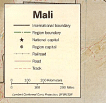
Location in West Africa at the South edge of the Sahara
Population approx. 11.5 million; about 8.5 inhabitants/km²
Life expectancy 47.5 years
Area comparative 3 times the size
of Germany or slightly less than twice the size of Texas
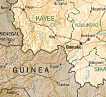
Border countries to the north & east Algeria, to the west Mauretania and Senegal, to the south Guinea, Cote d' Ivoire, Burkina Faso and Niger
Mali offers colourful markets, exotic mosque architecture, fascinating history, legendary Timbuktu, the edge of the Sahara, the great river Niger, Dogon Country, ...
Planned arrival December 2003
January 8, 2004 Bamako – STOP, police!
Coming from Ethiopia where we had had difficulties spending our money,
we suffered a severe price shock upon arrival in Bamako. For whatever
reason, everything from basic accommodation to food and drinks is expensive,
even compared with European standards if one compares value for money.
The city of Bamako did not leave a very positive impression on us. Situated
in a valley, the exhaust fumes of thousands of mopeds and the dust of
many dirt roads cannot escape and cover the city in smog.
The foreign police also did its share to prevent us from liking the town. We simply wanted to prolong our visa for one month and that proved to be a bit more time consuming and difficult than we had expected. First, we had to find the correct office. Once there, we managed to locate a tiny aisle at the end of which, set against a wall, stood a plain table seating two government employees. The table was covered with plenty of foreign passports, several money stacks lying loosely scattered around, paperwork and dog-eared record books with greasy margins and amidst all stood two coffee mugs. After a while, we managed to interrupt their chitchat with other officials and received two forms each. We completed all of them, one of the walls providing efficient support. When we were ready to hand in the forms, four passport photos and money the officials were so kind to inform us that the office was now closed and we had to pay at the Tresor as it was not the job of the foreign police to collect money.
First thing the next morning we went to the Tresor, an impressive building in the centre of town that read “Tresor” over the front entrance. People there were friendly but sent us from one floor to another and everybody told us that the foreign police deals with visa issues. Hence, we walked back through dusty Bamako to the foreign police’s office. Luckily, we met a guy from the German Agro Action there who also had to extend his visa but had a colleague along who knew where to purchase the required tax stamps.
At the side of a nameless building somewhere in Bamako hides a little booth with iron bars and a small window where one has to state the required amount, hand over the money and receives the small paper stamps in return. We would have never found the place without the guy’s help! Once again we returned to the foreign police’s office to submit everything and came back one more time late in the afternoon to collect our passports with the extended visa and stamped tax stamps.
Exchanging money was another hot issue and once we had enough CFA to get us around Mali, we left Bamako behind and headed for Segou and Djenne.
Djenne – Back in time
Buses do not go into Djenne but passengers heading there have to get off
at a junction 30km out of town. Luck was not on our side this time as
a small taxi had just filled up when we arrived and we had to wait for
the next one to fill up. As nightfall was not far away, we started tossing
around the thought of camping at the junction. Yet, an hour later enough
passengers had piled up and the one-eyed car, only the right front light
was working, managed to reach the oldest known city in sub-Saharan Africa
in no time. Touts welcomed us kilometres before Djenne at the ferry crossing
but we handled them much better than at the beginning of our trip (Stone
Town, Zanzibar…) and lost them after a few minutes. By now, we are able
to offer seminars on how to get rid of guides (at good price!).
We found a nice roof for the tent to stand on just across from Djenne’s famous mud mosque. This roof became our base during the mornings and evenings (it was unbearable up there during daytime) for the next three days. Greg and Jo, a South African couple, were the owners of the second tent up there and together we enjoyed to watch the life on the streets around us.
Monday is market day in Djenne. Throughout the morning, merchants
and buyers arrive to set up stalls, inspect goods and exchange news. The
market only gets into full swing around
It was just as amazing to see Djenne on Tuesday: a sleepy town with empty streets and hardly any people. We enjoyed the tranquillity of the old town and wondered around through the narrow, dusty alleys shaded from the sun by the old one and two-storey mud brick buildings. We peaked into many courtyards, examined the children’s homemade toys and carefully tried to avoid stepping into the open sewer system or bumping into the free-roaming chicken and sheep.
Two days later, we longed for further adventures and left behind the city whose merchants long ago founded Timbuktu.
Dogon country – Up and down the cliff
Every tourist to Mali visits Dogon country. Hence, we were not sure about
how touristy the area would be. In Sevare we met three Dutch and a Belgian
couple who were also heading there and the seven of us decided to team
up for three days of hiking in Dogon. We copied names from a list with
good and bad guides at our hotel in Sevare and told people at a hotel
in Bandiagara that we were looking for Sory Ibrahim Karambe. Minutes later
Sory appeared and showed us his ID card to prove his identity. We were
positively surprised by so much professionalism and immediately started
to discuss our ideas of a trekking trip. Half an hour later we had probed
Sory’s knowledge of the area and the Dogon people and had reached an agreement
over the price. All was manifested in a written travel agreement and we
were convinced that we had found a good guide. The next days confirmed
our first impression. Many other tourists had problems with their guides
we did not. Instead, we had very interesting discussions about life in
Dogon country and Mali in general.
Despite all of the tourist hype, the Dogon people seem to have managed to preserve their facetted culture and religion. Their homeland is the Falaise of Bandiagara, an escarpment that extends some 150km through the Sahel, the zone of semi-arid scrub savannah. The Dogon’s small flat-roofed houses are built of rock and mud and set in a compound that also contains one or two granaries with conical roofs. Some of the villages cling high up against the rock of the falaise. Most Dogon, however, have moved their houses down into the plain closer to their fields and water supply.
All over the walls of the falaise in the most inaccessible places, one can spot other dwellings and stores that were built by the Tellem, the people who inhabited the area before the Dogon. Today scientists believe that the rocks were covered with vines and creepers in the past, which served as natural ladders.
Our first overnight stay in Dogon country in Teli, a small village at the southern end of the cliff, was very enjoyable and rather intimate. Our group stayed in a small campement with a family who prepared our dinner in the courtyard. After dinner, we listened to Sory reciting an American’s notes on Dogon religion and culture whilst watching the night sky unspoilt without electricity around. The two of us pitched our tent on the roof of the house, went to bed early and listened to the sounds of the village and a lost donkey that had difficulties finding its way back home.
The village’s cocks started to greet the approaching daylight as of 4am, the sign for the women to get up to fulfil their first task of the day – fetch water from the pump or well and carry it home on their heads.
After packing up, we started the day with breakfast and a walk through the old village higher up in the cliff. Most houses remain intact, old pottery is lying around and the front wall of the former house of the chief of the hunters is still covered with monkey, bird and rabbit skulls. The views from up there are tantalising but what work must it have been to carry everything up!
We enjoyed the trip so much that we decided to trek for three more days after a two nights rest in Bandiagara and seeing off the rest of the group. Sory accepted to be our guide for a second time and made for another pleasant trip. We climbed up and down the escarpment, enjoyed the views, people, excellent couscous and rice with different sauces and bargaining about souvenirs. We also liked the change in flora – whereas the plain is rather sandy in the south, it became greener and greener the further north we walked. What we really did not like were some other tourists whom we met in the evenings in the campements. They kept on complaining about the path having always the same sandy appearance, the diet being boring (an Italian complained about the pasta not being properly prepared), the guides being uninformed and too expensive etc. We do not know what they expected and were seriously wondering what on earth made these people leave their all-inclusive resorts and come to Mali.
River Niger – Going with the flow
The Niger, Mali’s lifeline, is a stunning element. It moves forward masses
of water all the way up to the edge of the Sahara, flowing 1626km through
the country. The river is not very deep but often so wide that one can
hardly see both banks. Its Inland Delta is a maze of channels, swamps
and lakes with palm-lined oases. According to what we have seen fish is
abundant, as are birds. The odd hippo also makes an appearance.
We saw only the small stretch of the waterway between Mopti and Timbuktu, a three-day journey with a pinasse, a motorised boat bigger than a canoe with a reed mat roof to keep off the sun. For the first time during our trip did we opt for the luxury mode of transport, a small tourist pinasse and not one of the public cargo boats. The tourist pinasse was ready to leave Mopti’s harbour when we arrived and we liked the idea of benches to sit on instead of rice sacks or other cargo. Every so often, the mind needs some tranquillity to recuperate in order to be again able to be friendly and return a smile at all of the excited children, merchants and guides. And tranquillity was what we got on the boat. Lying on the roof, we watched heavily laden boats sail upstream for Mopti, fishermen tossing out their nets and Bozo families in small canoes moving downstream with their household.
The Bozo fisher people live alongside the river in simple one-room mud houses. A family has several constructions along the river, moving upstream and downstream according to the water level and the fish. We saw many families repairing their houses just north of Mopti whereas most of the settlements further downstream were still uninhabited and heavily damaged from the last rainy season. Young and old were waving, screaming and genuinely jumping for joy at the sight of so many tubabo on their river.
At other times, we had the river to ourselves. Watching a pied kingfisher overtaking the boat with ease, gracefully diving for fish and giving high-pitched warning signals to its companions whenever the boat came too close, was truly relaxing. Unfortunately, a bag of peeled peanuts spoiled the peacefulness for a night as Christian’s intestines decided to revolt against the nourishment and left a half circle of toilet paper around our tent. From then on, we fell back on the old boy scout rule – cook it, peel it or forget it!
Timbuktu – Christmas on the beach
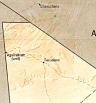
It is an otherworldly experience to witness the loading of forty camels
who thereafter set off into the Sahara with four human companions for
a month-long return journey to the salt mines at Taoudenni, about 740km
north of Timbuktu. These men are tough and some of the real desert nomads
left. Except for their apparel they do not seem to have much in common
with the guys who have to make a living by convincing tourists that they
are Tuaregs and that the knifes and jewellery which they offer for sale
are worth the price and a good souvenir to take home.
Life in Timbuktu is harsh; the town is isolated at the southern edge of the Sahara, the climate is hot during the days and cools at night and the desert sand accompanies every move. The town’s former grandeur is now invisible but the past does seem to be present when wondering through the sandy streets. It is not easy to imagine why so many Europeans risked their lives to reach this place. It is even more difficult for us to imagine life under these conditions. No wonder that many inhabitants try to milk as much money as possible out of the tourists who all come to be able to tell friends that they have been to Timbuktu and made it home. (Apparently, there is a monthly roundtable in New York for such people!) Most tourists do not spare more than a few hours.
We stayed for a week, partly because the trip there had been expensive and the journey back would again be costly and partly because we like to soak up the atmosphere of a place after the merchants and guides know you and leave you alone. We also got to see what most tourists ignore or do not have the time to take a look at. In contrast to all of the sand that surrounds the town, the river Niger passes by a few kilometres south of Timbuktu. We spent several hours sipping cold drinks, watching boats float by and chatting the afternoon away on the shore at a place where sand dunes reach all the way to the water.
We were also surprised to learn that a channel connected Timbuktu with the river until the early 1980s and that there was a small harbour in the middle of town. Today, the site of the harbour is used to produce and dry mud bricks for house building. The quality of the bricks determines how well a house withstands the yearly rainy season from June to October. The 2003 rains brought more water than usual and it rained well into November, leaving many houses washed down but making farmers very happy. What made us very happy was Matthias’ invitation to celebrate Christmas Eve at his house with some other white-noses. The ded, German Development Service, has sent him to Timbuktu for two years to work on decentralisation and be a counterpart for the town’s mayor.
A long dining table on Matthias’ front porch seated sixteen hungry people and was loaded with two grilled sheep, yummy potatoes and lots of salad. The thirteen Europeans around the table were in despair for a bit when Matthias started eagerly to rip meat off one of the sheep by hand. We first had to put aside the thought that the sheep had walked through the gate in the afternoon, hung from a nearby tree shortly thereafter and had now been placed on the table crisply grilled. Moments later, we all followed suit and enjoyed the jolly feast. We enjoyed many more relaxing hours at Matthias’ home and Anja was grateful for the couch in the cool living room when being knocked out by a severe summer flu/ Malian winter flu whilst the air in the tent on a nearby roof was too hot and sandy to bear.
Leaving Timbuktu proved to be more difficult and expensive than we had expected. We eventually managed to reserve two seats in a vehicle that was to leave the next morning at 4am. Packing the backpacks in the dark on a roof is still a challenge especially if it is freezing cold (around 10 degrees Celsius) and windy. However, the car arrived with only minor delay and we set off in a battered Land Cruiser with nine other people to tackle the 500+km to Douentza. From the start the tires had not looked promising but did they have to go flat four times? After ten hours on the road, we reached Douentza where an aggressive crowd of men greeted us and charged double the price for a bus ride to Sevare where we wanted to spend the night. The day had been chosen to be our breakdown day as the bus driver managed to overheat the engine and the bus responded with a leakage in at least one oil system. We reached Sevare around 6pm, totally exhausted and resembling vagabonds. Mac, the owner of the hotel we had stayed in before, welcomed us warmly and we treated ourselves to a filling dinner and a cleansing shower washing 600km of dirt road off our skin.
Some Peace Corps volunteers and their visiting families enabled us to set out for another day of travelling. They had hired a minibus with some spare seats and left for Koro directly after breakfast the next morning. Hence, we jumped back into our dirty clothes, on the minibus and off another bus at 10pm in Ouagadougou, Burkina Faso’s capital.