Ethiopia Itinerary
 |
|
|
|
|
 |
 |
 |
 |
|
 |
 |
 |
||
 |
 |
 |
||
 |
||||
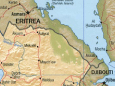
Location Horn of Africa
Population approx. 67 million; 57 inhabitants/km²
Life expectancy 40.5 years
Area comparative France and Spain
combined or slightly less than twice the size of Texas
Border countries to the north Eritrea, to the west Sudan, to the south Kenya and to the east Somalia and Djibouti
Ethiopia offers ancient history, spectacular scenery & fascinating culture. The land of King Salomon and Queen Sheba. Ethiopia's history streches back some 4.4 million years when the oldest human ancestor ever found walked its terrain.
Planned arrival November 2003
November 30, Tired of minibuses or just enjoying
city life?
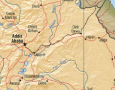
Addis Ababa, the city which we did not like one bit during our 24 hour
stopover in July, made us hang about for over a week this time. We walked
kilometre after kilometre every day, checking out one pastry shop and
one restaurant after another. It is actually not really true as we quickly
settled for one of the pastry shops and became regular daily customers.
Perhaps the weather also made a difference. It was pouring down in July
whilst we had warm sunshine every day in November.
In addition, we had had this sudden idea that we wanted to devote our time in Ethiopia to volunteer work, both taking a break from travelling and experiencing something new. It turned out that this was easier thought than done. We had very interesting conversations with the Public Information Officer of the World Food Programme in Ethiopia, with the Head of the GTZ in Addis, with a German stagiaire at the German Development Service (ded) and the Project Co-ordinator of Menschen fuer Menschen. All of them were very pleased with our offer but all had to point out that there was nothing they could do for us as we only had a tourist visa. The Ethiopian law is a little bit bizarre when it comes to foreigners who would like to work/volunteer. For instance, the spouse and children of a UN official get a nice stamp into their passports when they first enter the country showing that they are not allowed to work, not even unpaid or for charity. Even if a spouse is a doctor, he or she is not allowed to work, not even unpaid. The government says that this is to safeguard the available jobs for Ethiopian nationals. A very nice idea but whether it works is another question. We find it rather odd and the individuals from the international organisations we spoke to agreed. Because of this many internationals do not want to work in Ethiopia.
We were somewhat disappointed after these findings and could not decide whether we should go back to travelling or wait for an opportunity to evolve. The appearance of Roene and Madlen, a well-travelled Swiss couple, at our campsite made leaving even more difficult. Hence, we stayed for a few more days, eating terrifically good and cheap food, chatting the mornings and evenings away and visiting our favourite pastry shop.
Volunteers after all!
Waiting turned out to be the right thing as the opportunity emerged to
help out in a private kindergarten in a small town called Adaba. Adaba
is situated in the Bale mountain region in Southern Ethiopia. It has a
population of approximately 15.000, one main street with a few basic hotels,
restaurants and shops as well as an AGIP petrol station. One telephone
line connects the village to the outer world and a mosque is currently
being built. Wednesday and Saturday are market days in Adaba when all
of the farmers from the villages high up in the mountains ride down to
sell their produce: tomatoes, potatoes, tef (local grain used to make
injera, a large, thin, pancake-shaped foam-rubber texture which tastes
a bit sour and is used to scoop accompanying sauces into one’s mouth),
onions, garlic, cabbage, beans and eggs. Apparently, the local outlet
of the ministry of agriculture is currently trying to introduce the horticulture
of some fruits but we could not find any.
Getting off the bus in Adaba was easy but to convince people that this was really the place we wanted to get off was much harder. Usually tourists just pass through on their way to Dinsho and the Bale Mountains National Park. Locals replied to our questions concerning the whereabouts of the kindergarten by gesturing and shouting: ”You, You, Dinsho, Dinsho, No Adaba!” Drawing a picture of the sun and rain clouds eventually led us to the Rainbow Kindergarten where the headmaster greeted us warmly. The 60 children were a bit shy at first but very soon took advantage of having two foreigners (faranji) within touching distance. At the end of each day we had to thoroughly wash our hands and faces after returning home. But a feeling of being over welcome and in a special way highly respected in the kids’ eyes left a satisfying smile on our freshly washed faces…
Upon our arrival in the little town, Mulugeta and Shiferaw, two pastors, who had already given one of their bedrooms to Marakie, a cheerful computer teacher from Addis Ababa, vacated the second bedroom and slept on the living room floor in order to accommodate us. Their hospitality was overwhelming and we very much enjoyed staying with them in one of the few stone houses in Adaba.
On our daily walk through town and across the market square we were always greeted by all of the children who caught our sight. Many hands had to be shaken and we surely know how to state our names by now… Fortunately, most of them realised after a few days that these faranji were not going to hand out any cash. Before, “What is your name” was immediately followed by “Give money!”
The children at the kindergarten, however, acted very differently and polite around us and we loved playing with them throughout the breaks. During classes Christian was busy making new toys from the available materials (wood, rubber, rope and bamboo) and Anja observed some of the classes and tried to understand the differences in kindergarten education in Ethiopia and in Germany. Parents in Ethiopia send children to kindergarten in order to prepare them for primary school. Whereas that is probably also one goal of European parents, this is the only objective for parents in Adaba. Hence, children from three years onwards sit on chairs behind benches, shouting the alphabet according to the teacher’s stick. We would have loved to see a better balance between the parents’ demand for a written proof of their offspring’s weekly progress on Friday and our ideal to let the children learn to play with each other, to share things, to be creative and to behave. Two weeks could only give us a diminutive insight into these matters and we did not want to take over the role of experts who we are surely not. We tried to give some good examples and provide the teachers with some new ideas. In Ethiopia, people have to absolve a three month course in order to become a kindergarten teacher. The ones in Adaba were very young and obviously scared to make mistakes, hence, they do as they have been taught. Fortunately, the owners of the kindergarten and the headmaster have a very different concept of education in mind and we are optimistic that things will change over time.
To work for a few weeks was the right decision after all and we will always remember our experience of Ethiopian rural life. It is possible to live a happy and fulfilling life with a hole in the ground outside with water that has to be brought from 150 metres away out running
Trekking in the Bale Mountains
We spent the weekends walking and trekking through the surrounding area
of Adaba. Firstly, we went for a short walk around town and the following
day for a hike to Meribo waterfall. Both times we entertained ourselves
by struggling to cross streams on dry feet.
On our second and final weekend in Adaba we went on horsebacks higher up into the Bale Mountains spending two nights at very well equipped mountain huts. As cattle is grazing in the forest areas – a mere few old trees by German standards – the forest floor is cleanly swept and bare of any rotting old branches or sticks since these are regularly collected as fuel.
The landscape we encountered in the region is very scenic, largely untouched by touristy aims and no comparison to our earlier perception and expectation of Ethiopian rural areas. Wheat and tef fields cover the rolling hills interspersed with lush green grassy patches and forests. The images of desert-like conditions certainly do not apply to this part of Ethiopia. We could not believe how green the Ethiopia is that we have seen!
Nevertheless, it was also a bit sad to imagine that the last remaining trees will be gone in twenty years time as no young trees are allowed to replace the old ones.
Lake Birds at Ziway and Awassa
Before arriving in Adaba, we stopped along the way to visit Lake Ziway
and Lake Awassa. Both lakes are great for bird watching and even appealed
to Christian as the birds were big enough to attract his attention: pelicans
and marabous as well as quite a number of large birds of prey line the
shores. And that sums up just about everything we did in these two towns:
sipping a coke or a coffee and eating some pastry while enjoying the view
across the lake with its abundant bird species. When we were not bird
watching we were riding buses along the busy roads. However, it is not
ordinary means of transport which populate these roads but people, donkeys
and cattle. Instead of clearing the path before an approaching motor vehicle
they seem to be utmost disturbed by the intruder and just stop in the
middle of the road or run across just metres before the vehicle. The
bus drivers try their best to win back parts of the tarmac for their vehicles
making excessive use of the horns and showing their extraordinary zigzag-skills
while calming their nerves chewing green chat leaves, a popular local
narcotic. Ethiopian traffic at its best and our lives one
way or another at risk (forget about all those terror warnings – this
is dangerous!).
German Luxury Abroad
Safely back in Addis we are currently staying at the guesthouse of the
German Development Service (ded). The sight of a flushing toilet, running
warm water, an almost spotless kitchen (yesterday we found a dead rat
in the back of the oven) and a well-equipped common room almost made us
jump for joy (especially onto the toilet seat…). During our short week
here we very much enjoy the many restaurants and coffee bars where one
can treat himself/herself to pizza, ice cream, macchiato or an Ethiopian
version of black forest cake. However, we also have to admit that Ethiopia’s
hospitality and friendliness has on two occasions been spoilt by Addis
Ababa’s petty crime. It was here that people tried to pickpocket us for
the first time in five months of African adventures.
From Addis Ababa we will fly to Mali and Burkina Faso for eight weeks on the very early morning of Dec 2nd. Djenné’s mosque, Timbuktu, the Niger River, Dogon country, minibuses and hopefully many pleasing adventures will be waiting for us in West Africa. Germany will have us back for about a week in February after landing in Frankfurt on Saturday, Jan 31st, at 06:30am from Addis. We would love to see you then if you can arrange it! But before – not knowing what the internet connection in Mali will be like – we would like to wish you all a peaceful Christmas season and a Happy New Year!